
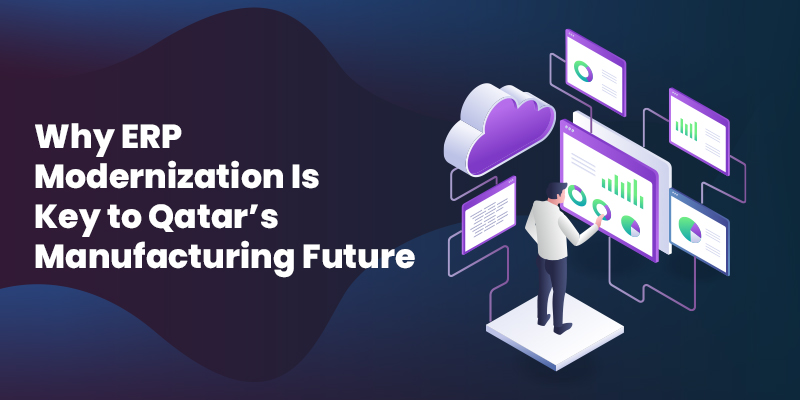
Why ERP Modernization Is Key to Qatar’s Manufacturing Future
The manufacturing sector of Qatar is showing more promise than ever before. Companies are bidding on a diversification strategy, and the country is moving away from dependency on industries related to oil and gas.
Manufacturing, logistics, and technology have emerged as major drivers under Qatar National Vision 2030. On a global scale, ERP modernization is the oil in the growth; companies are pouring investments to make it an optimal process.
Traditional ERP systems that are fragmented, on-premise, and manually driven no longer fit the pace of modern Qatari manufacturing. As factories expand their production lines, manage distributed supply chains, and adopt advanced technologies such as IoT, robotics, and predictive analytics, they need intelligent systems.
Cloud-based manufacturing ERP comes in here.
Modern ERP is not just about digitizing the workflows; it’s connecting everything in the manufacturing ecosystem, from procurement to production and from inventory to compliance, on a single intelligent platform.
Providing end-to-end visibility with real-time insights into operations, costs, and performance across multiple facilities is essential. Predictive intelligence is data-driven forecasting to anticipate demand, reduce waste, and optimize efficiency, not a task you want to entrust with amateur providers.
As the country works its way toward a future-ready industrial base in line with smart manufacturing, sustainability, and global competitiveness, ERP modernization is not a luxury but a strategic necessity.
The Cost of Staying Legacy: The Reasons Traditional ERP Holds Qatar Back
Many enterprises are still dependent on legacy ERP systems, characterized by their rigidity, much outdatedness, and disconnection from the realities facing them today. These systems did work well a decade ago, but have now become a barrier in the way of achieving agility, scalability, and competitiveness in 2025.
Here’s why sticking to traditional ERP is holding Qatari manufacturers back:
1. The Problem of Fragmented Operations and Data Silos
Legacy ERP often does not integrate seamlessly with modern production tools, IoT sensors, and external supplier networks. The result is that most manufacturing companies end up with fragmented data across finance, procurement, production, and logistics. Fragmentation limits real-time decision making and increases operational blind spots, especially critical when it comes to managing multiple plants or regional supply chains.
2. The Burden of Manual Workloads and Inefficiency
As one might expect, older systems require human involvement in routine processes like production planning, tracking inventory, and reconciliation of finances. This delays output while increasing the chances of human error, thereby leading to inaccurate reporting, delayed delivery, and affecting customer trust and profitability.
3. The Limitation of Scalability and Flexibility
The industrial development of Qatar increasingly needs systems that can scale rapidly with new product lines, partnerships, or export markets. In addition, legacy ERP systems cannot withstand the dynamic changes associated either with productions’ volume or with changing regulatory frameworks. Modern manufacturing ERP is cloud-based and modular; therefore, manufacturers can extend their operations easily and with no costly downtime.
4. The Absence of Predictive Insights
Data is the new currency of manufacturing, but legacy systems can’t mine it effectively. Without predictive analytics, it’s impossible for manufacturers to predict demand, forestall supply chain bottlenecks, or optimally plan production schedules. The results are overproduction, excess inventory, and wasted capital, major roadblocks in a competitive market like Qatar.
5. The Challenge of Compliance and Localization Gaps
Besides changing local regulations, there are also emerging sustainability and trade requirements reaching the manufacturers in Qatar. Conventional ERP systems are many times based upon global templates, with very limited localised compliance features like real-time reporting necessary for seamless audit and operational transparency.
How Modern ERP Accelerates Qatar’s Manufacturing Growth
While Qatar’s manufacturing sector is competing locally, it is scaling up regionally and globally. This ambition now requires much more from the manufacturers than just operational control; it needs data-driven agility. This is where modern ERP systems come into place, integrating AI, automation, and cloud intelligence to help manufacturers predict, adapt, and act in real time.
Here is how modern ERP systems are driving Qatar’s next wave of industrial growth:
1. The Role of Real-Time Visibility Across the Production Ecosystem
Modern ERP integrates every operational touchpoint in real time, from procurement of raw materials to the shop floor and distribution. Through real-time, centralized dashboards, it gives manufacturers a 360-degree view of production performance, cost centers, and order pipelines.
This would provide full visibility of the orders, thereby enabling the decision-makers to identify bottlenecks much earlier to minimize losses through downtime and ensure timely deliveries, which are crucial in maintaining export competitiveness for Qatar.
2. The Impact of AI-driven Forecasting and Predictive Maintenance
Gone are the days of reactive manufacturing. AI-driven ERP solutions use machine learning to forecast demand, anticipate equipment failures, and optimize production schedules.
Predictive maintenance, for instance, made possible with analytics in ERP, can detect the likelihood of machine failure well in advance for proactive repairs that will help avoid expensive disruptions. This is very important in the energy- and output-intensive industries of Qatar, where uptime directly affects profitability.
3. The Function of Smart Inventory and Supply Chain Optimization
However, modern ERP is about optimizing inventory rather than just tracking it. AI algorithms analyze consumption patterns, supplier performance, and logistic timelines to maintain stock levels at optimum. This avoids overstocking and stockouts while being fully aligned with Qatar’s sustainability goals of reducing waste and improving resource efficiency. The agility gained from the approach provides them with quick responses to any shift in the global supply chain, either from the volatility of the markets or from shipping disruptions.
4. The Advantage of Built-in Compliance and Localization
Modern ERP solutions, such as HostBooks Enterprise, have regional compliance in mind. For Qatar-based manufacturers, this automatically provides compliance to local tax, reporting, and workforce regulations, without the need for human intervention.
With integrated audit trails, document digitization, and multilingual support, including Arabic, manufacturers can scale with confidence, knowing they remain compliant.
5. The Importance of Cloud Scalability and Secure Access
With modern ERP applications becoming cloud-native, for instance, manufacturers are able to expand across locations without constraints around infrastructure. Whether opening a new facility in the Industrial Area or with international suppliers, cloud-based ERP means secure and real-time access from anywhere. This flexibility supports Qatar’s hybrid and distributed manufacturing environments where remote collaboration and multi-location visibility are becoming the norm.
HostBooks Enterprise: Powering Qatar’s Manufacturing Transformation
As Qatar strides closer towards industrial Vision 2030, the role of technology partners will become increasingly significant. HostBooks Enterprise is more than just an ERP; it is a manufacturing intelligence platform designed to simplify the complex, integrate operations, and fuel growth across Qatar’s ever-evolving industrial ecosystem.
Here’s how HostBooks Enterprise ERP redefines manufacturing efficiency in Qatar:
1. The Advantage of Unified Control Across Every Function
HostBooks integrates finance, manufacturing, procurement, inventory, HR, and compliance into one intelligent platform. No more siloed data; only one single source of truth that delivers real-time visibility across departments, facilities, and supply chains. This single view will enable plant managers, CFOs, and operations heads to make much faster, data-backed decisions to improve the efficiency and profitability of production.
2. The Power of AI-First Manufacturing Intelligence
HostBooks ERP, powered by Agentic AI, learns from the data rather than simply recording it. It detects inefficiencies in your processes, it foretells demand, and automatically optimizes schedules. For example, manufacturers will be able to forecast raw material requirements, predict maintenance cycles, and even automate procurement approvals from one dashboard.
3. The Benefit of Cloud-Ready Scalability and Speed
Because it natively resides in the cloud, HostBooks Enterprise provides agility for scaling to manufacturers without any IT bottlenecks. Be it multi-site management or remote monitoring, cloud deployment ensures secure, real-time access to production and financial data anytime, anywhere. This also aligns with Qatar’s digital transformation drive, where agility, transparency, and accessibility are strategic imperatives.
4. The Necessity of Built-in Compliance and Localization for Qatar
HostBooks ERP comes with GCC and Qatar-specific business frameworks that automatically put regional regulations and reporting formats into practice. It further supports Arabic-English bilingual interfaces, local tax formats, and flexible approval hierarchies that blend perfectly with Qatari business culture. This ensures manufacturers stay compliant, focusing on excellence in operations.
5. The Value of Seamless Integration and Customization
Every manufacturing enterprise is different, and so is HostBooks. Seamless integration with your existing machinery data systems, MES, and providing custom automation of workflows, this ERP changes shape according to the operations instead of forcing them to adapt to rigid templates. The result is a personalized manufacturing control center that changes as fast as your business.
From Vision 2030 to Factory 2030: How ERP Modernization Powers Qatar’s Industrial Ambitions
Qatar’s National Vision 2030 encourages diversification away from hydrocarbons, while manufacturing, logistics, and advanced industries remain the essential elements for growth. Modernizing the ERP has turned it into a digital backbone, empowering this transformation.
1. The Alignment with Vision 2030’s Industrial Roadmap
Qatar will further scale up the output of its local manufacturing industries and establish high-tech industries. Advanced ERP systems, particularly AI-driven and native-cloud platforms like HostBooks Enterprise, build a framework for scaling operations, improving productivity, and producing world-class quality standards. They turn conventional factories into digitally integrated firms and thereby respond well to the call of Vision 2030 for innovative and economic sustainability.
2. The Role of ERP in Enabling Smart Industrial Cities
Meanwhile, initiatives ranging from the Umm Alhoul Free Zone to Ras Bufontas Industrial City are promoting connected, smart industrial ecosystems. ERP becomes the nervous system that mixes real-time production data with logistics and workforce analytics in such a scenario. HostBooks ERP empowers manufacturers operating in these zones to integrate data throughout multiple facilities, supply chains, and compliance frameworks for complete operational transparency and sustainability.
3. The Contribution to Fueling Supply Chain Localization
The post-global disruptions have pushed Qatar towards self-reliant manufacturing and localized supply chains. Likewise, modernizing ERP means that business firms are able to track materials, monitor supplier performance, and forecast demand on one screen for efficient operations. This strengthens Qatar’s push to ensure “Made in Qatar” manufacturing also maintains efficiency and national supply chain security.
4. The Importance of Enhancing Export Competitiveness
However, to compete in the GCC and global markets, real-time visibility of cost, margin, and logistics is needed. HostBooks Enterprise has AI-driven analytics that allow businesses to find out the most profitable export channels, handle multi-currency transactions, and be compliant with the regulations of cross-border trade. ERP modernization thus acts as an enabler of growth, not merely an internal upgrade.
Why ERP Modernization Defines Qatar’s Industrial Edge
The manufacturing landscape in Qatar stands at an important juncture. With massive investments in digital transformation, industrial diversification, and sustainability, the modernization of ERP is no longer about upgrading the technology but a strategic imperative for growth and competitiveness.
1. The Foundation for Building Future-Ready Manufacturing Ecosystems
Modern ERP systems like HostBooks Enterprise form the core of this new industrial wave that bridges operations, intelligence, and innovation. Powering manufacturers with AI, IoT, and cloud computing, it enables them to transition from reactive to predictive operations: predict disruptions, optimize costs, and ensure uninterruptible production in a turbulent supply chain globally. It is this proactive ability that will mean the difference between survival and thriving in Qatar’s post-energy economy.
2. The Role in Enabling Smarter, Sustainable Manufacturing
Whereas industrial growth is in focus, the Qatar Vision 2030 lays emphasis on sustainable industrialization. Modern ERP systems enable manufacturers to track energy consumption, optimize resource usage, and reduce waste by using real-time analytics. Companies will be able to balance profitability with sustainability using such tools as predictive maintenance and smart demand forecasting, a balance which global investors expect.
3. The Impact on Driving Local Innovation and Global Reach
HostBooks Enterprise gives Qatar manufacturers global-grade digital infrastructure built for local needs. This combination empowers enterprises to compete internationally without losing regional compliance or cultural alignment. ERP modernization thus helps the manufacturing sector in Qatar extend beyond local optimization into regional production hubs serving the GCC and international markets with ease.
4. The Importance of Empowering the Workforce of Tomorrow
With smarter factories, the nature of the workforce also needs to evolve. Truly modern ERPs would arm teams with real-time data, mobile access, and automation of manual workloads, enabling employees to move beyond transactional activities into strategic decision-making, underpinned by actionable insights that drive a more agile, skilled, and data-literate workforce across Qatar’s industrial zones.
Why Modernization Is No Longer Optional
For Qatar, the question is no longer whether manufacturers should modernize or not, but how fast. ERP modernization, driven by intelligent solutions such as HostBooks Enterprise, helps the manufacturer realize speed, precision, and scalability: the three pillars of industrial success in a competitive global market. As the country gears up toward Industry 4.0 and Vision 2030, it is clear that ERP modernization will define who leads Qatar’s manufacturing renaissance and who gets left behind.


Leave a Reply